Open notebook · last updated 23 September 2026
I have been hard of hearing since I was ten or eleven. In 2020 it got a name. Now I know which letter it is.
My hearing loss is hereditary. It has run in the family for at least four generations. The cause is one wrong letter in one gene: MYO6. That gene is the recipe for a small motor protein that keeps the tiny sensory hairs in my inner ear in place. If that motor doesn't work properly, those hairs break down, the high tones first. This is what I know, what I'm trying, and where it gets stuck.
Translated from the Dutch original. The 3D explainers are in English; the logbook, the knowledge base and the linked background pages are in Dutch.
See it in 3D
five interactive 3D animations · with voice-over, always subtitled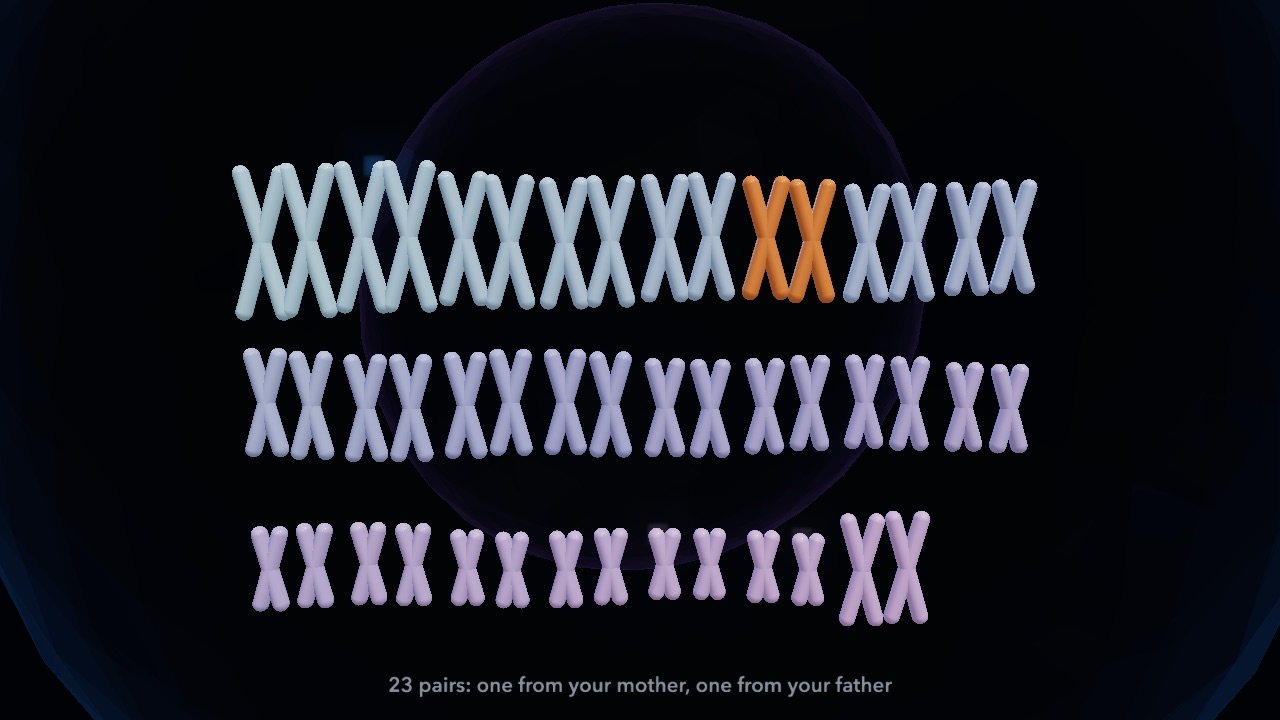
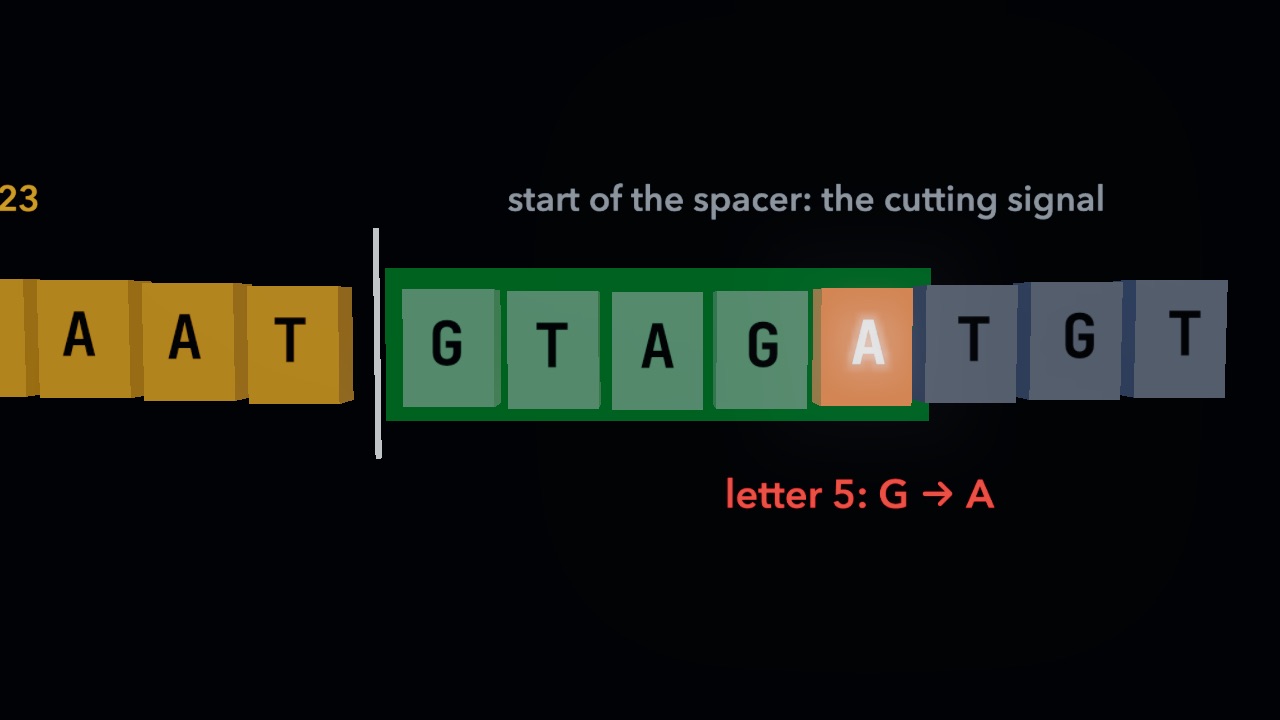
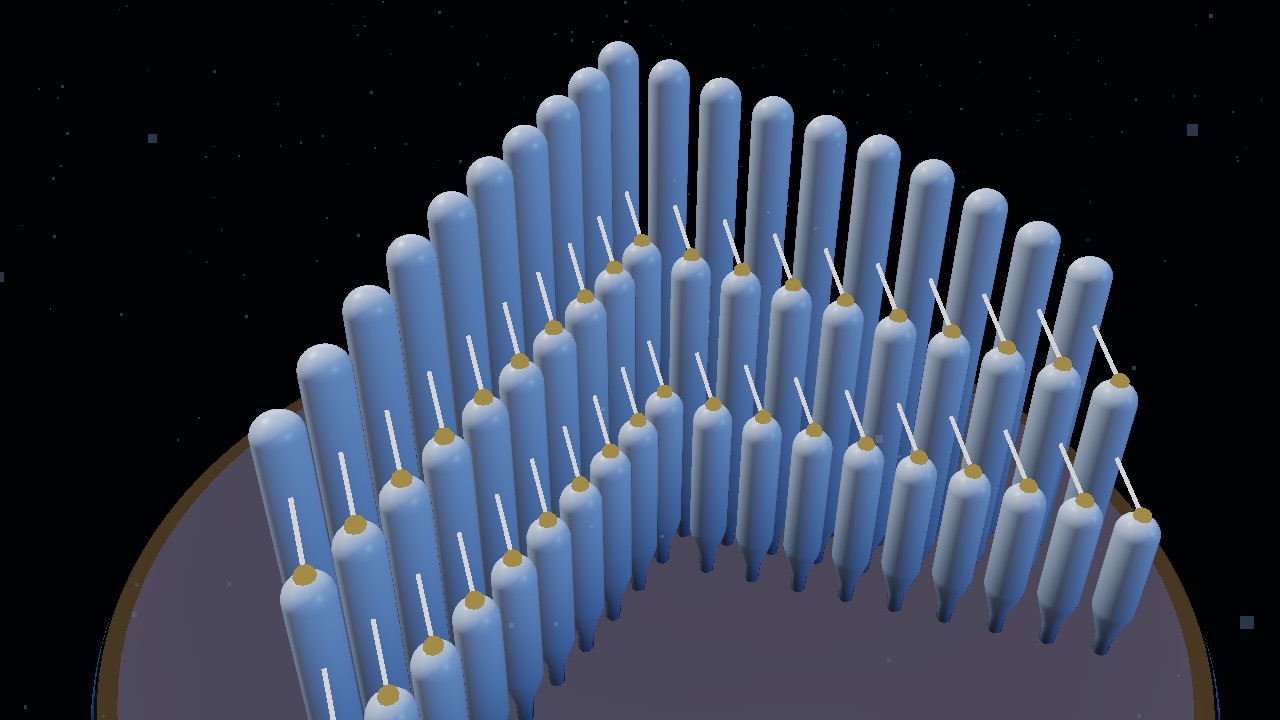
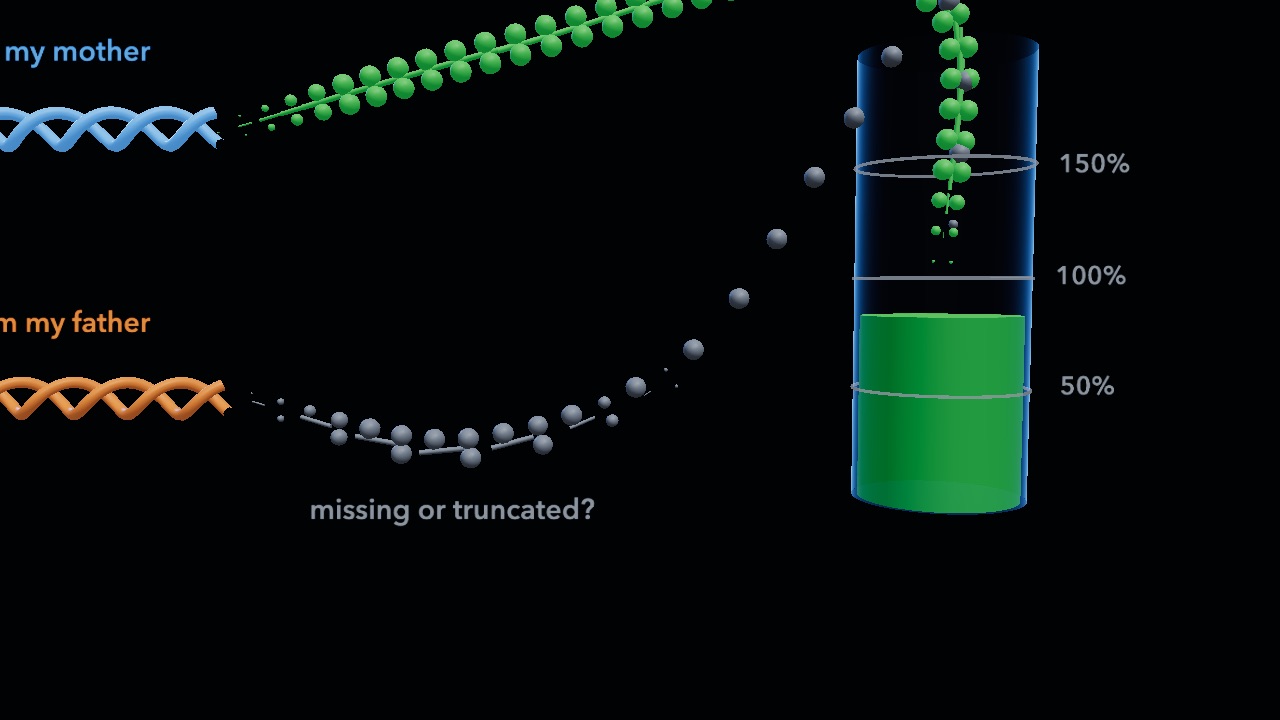
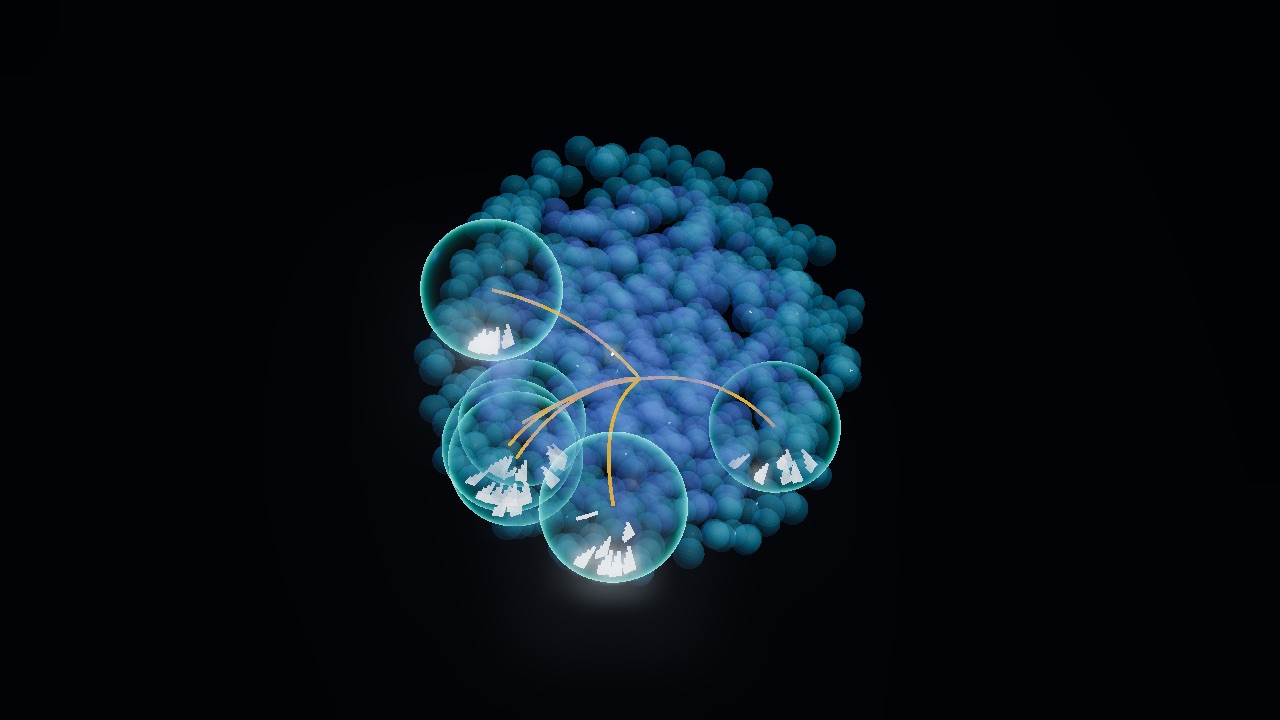
From my chromosomes to a mini-ear in a culture dish. Pause to look around for yourself; at the end of each part there is something to try yourself.
What it actually is
What I am losing is not volume, it is clarity
Say "hard of hearing" and almost everyone thinks of quieter. In my case that is the least interesting half of the story.
I have fourteen years of measurements. If you look at how loud sound has to be before I hear it, hardly anything has changed in the speech range: the point at which I pick up half of the speech sounds moved by five decibels in fourteen years. That is not much.
But play the sound at the same loudness and count how many words I understand correctly, and it drops fast. In 2012 that was 94 out of 100. In 2019, 85. In 2026, 70. Same loudness, fewer and fewer words right. And the rate of decline nearly doubled, from 1.3 to 2.2 percentage points per year.
left ear, unaided, everything presented at the same level of 100 dB
That is also how it feels. Speaking louder doesn't help, because the problem isn't that it is too quiet; it is that the difference between words like bed, bet and beg gets less and less clear. Hearing aids have improved a lot over the same period and largely make up for the decline, but that will run out at some point.
Why that fits this gene. Myosin VI is found, among other places, where the hair cell passes its signal on to the auditory nerve. If things go wrong there, this is exactly the picture you would expect: the threshold barely moves, understanding collapses.
And this is where in the sound it sits
Not everything is equally gone. One part still works, and that happens to be exactly the part that matters.
What happens in the cell
From one wrong letter to a sensory hair that falls over
Four steps. You don't need any biology, just the order.
- 1 · THE RECIPE
The MYO6 gene is the recipe for myosin VI, a small motor protein in the hair cell.
- 2 · THE ERROR
In one place there is a wrong letter, right at the seam between two pieces of the recipe.
- 3 · THE WORKING COPY
Because of it, a piece is skipped when the working copy is made, and the rest no longer reads correctly.
- 4 · THE CELL
The hair cell has only half of its motor. Presumably the base of the sensory hairs slowly wears down as a result, and the signal drops out, high tones first.
There are four short animations that show this step by step, all interactive and in 3D, plus an extra one on growing a mini-ear. They have a voice-over you can switch off; everything is also shown as subtitles.
▶ Watch in 3DFrom chromosome to protein
± 2:10 · Interactive, in 3D: from a cell via 23 chromosome pairs and the double helix to the MYO6 gene of 170,299 letters, how it is cut and spliced, and how myosin VI is made from it. With a zoom slider from cell to protein.
▶ Watch in 3DWhat my variant does
± 2:25 · Interactive, in 3D: the single letter at the seam of piece 23, the skipped piece, the stop signal that immediately follows as a result, and the two possible outcomes. At the end you can explore the reading frame yourself, with the real letters from the gene.
▶ Watch in 3DWhat myosin VI does in the hair cell
± 2:30 · Interactive, in 3D: from my ear to the cochlea, to a single hair cell. Pause to look around for yourself, and at the end pick a pitch to see which spot in the cochlea still responds.
▶ Watch in 3DThe dosage paradox
± 2:35 · Interactive, in 3D: why half a dose of MYO6 does cause disease, while others with the same half hear normally. At the end, a dosage slider lets you see what is known for each amount, and what is not.
▶ Watch in 3DExtra: growing a mini-ear
± 2:45 · From a tube of blood to stem cells (hiPSC) and an inner-ear organoid with real hair cells. What you can measure in it, and how that differs from a minigene and from blood. With a day slider to grow it yourself.
What part 2 does not establish
That piece 23 (exon 23) is skipped is a prediction by five computational models (SpliceAI 0.89, Pangolin 0.79, SAI-10k, AlphaGenome, Carbon-3B), not yet a measurement. If it is indeed skipped, the rest follows arithmetically: piece 23 is 130 letters, and the first triplet of piece 24 that is read after it is TGA, a stop signal at position 763. That has been checked against the sequence itself (Ensembl GRCh38).
Whether the message is then cleared away or escapes has not been measured; the RNA analysis on my blood is under way. That a truncated protein of 762 building blocks cannot couple follows from the domain map (UniProt Q9UM54: the coupling regions lie between 835 and 1285); the coupling mode itself is inferred in UniProt from related proteins. Whether a free, truncated motor does harm in some other way is deliberately left open in this animation.
What the organoid animation does not establish
The steps follow the published protocols (Koehler et al. 2017; Nature Protocols 2026): four signalling pathways, hair cells around day 40, culture up to day 150. Which compound is added on which day has been left out. The standard organoid resembles a young balance organ, not an adult cochlea; cochlear versions are in development. The turnaround time of almost a year for a new patient line is an estimate. The comparison table (minigene, blood, organoid) summarises what each method can measure; it is not the outcome of an experiment. The measurements are phrased as what could be done: this explains the method, it does not announce a study.
What part 3 does not establish
What goes wrong without myosin VI (the outer membrane lifts off the floor, the hairs fuse from the base up) comes from mice that have no myosin VI at all (Snell's waltzer; Self et al. 1999, PMID 10525338). That is not my situation: I have one working copy.
That with half a dose it happens more slowly, because the base of the hairs wears down over years, is also a mouse finding (heterozygous Myo6 mice, PMID 34619316) and is therefore shown as "presumably". Whether my second copy is missing entirely or exists as a truncated version has not been measured yet; that analysis is under way.
The position per pitch in the try-it-yourself section follows the Greenwood function for the human ear. The boundary where the damage begins is sketched, not measured. The head is a stylised silhouette; in reality the cochlea is about 1 cm wide and has three channels, simplified here to a single tube with the basilar membrane inside.
What part 4 does not establish
This animation states that half a dose of MYO6 is enough to cause hearing loss. That rests on one study, in mice (PMID 34619316): heterozygous Myo6-null mice develop mild but progressive hearing loss. That is not human data.
What that does not resolve, as the video also says: why carriers of the recessive form hear normally with the same half dose. Three explanations are conceivable (a mouse is not a human; their hearing has rarely been measured carefully; their variant may not be a complete knockout) and none of them has been studied. So it is one mouse study against one human observation.
Furthermore, dominant-negative damage is not ruled out; only the argument that it would be needed has fallen away. The constraint figures (74 observed versus 179 expected loss-of-function variants) come from gnomAD v4 and are a population statistic, not a measurement on me. The escape fraction of my own variant has not been measured yet; that analysis is under way. That is why the animation says my father's copy "makes nothing, or a truncated version".
The green window in the dosage meter is sketched. Only three points are observations: no myosin VI (severe, congenital), half (in me and in the mice: hearing loss) and one and a half to almost two times too much (one family, Hilgert 2008). Where "enough" exactly begins and ends has not been measured.
Where things stand now
On 27 July blood was drawn, and that will decide which treatment can work later
Cells are being grown from that blood. They are used to measure what really happens to that faulty working copy. There are two possibilities, and the difference is not academic.
Does the cell clear away the broken copy completely?
Then the broken copy simply makes nothing, and I just have too little motor protein. A treatment could then add a working copy. That is the simplest route, and since April 2026 there has been an approved inner-ear gene therapy that works exactly like that (for a different gene).
Or does a little slip through after all?
Then there is a half motor in the cell that may get in the way. Adding a copy will not help enough, and the error itself has to be corrected. That is possible in principle too, but it is a different and heavier design.
And this is where it gets stuck. The first question (is it indeed cut wrongly) is answered by the hospital laboratory. The second question (how much slips through) falls outside what a diagnostic lab does: that is research. Three labs have been asked so far and all three kindly said no, each for a good reason. Finding the fourth lab is the real bottleneck right now.
What I am pursuing in parallel
Not waiting for a single route. Four tracks at once, with very different horizons and very different odds. I am honest about which one really matters.
Adding the gene, or changing the letter back
Either add a working copy with a viral vector, or change the wrong letter back in place. The first ever cochlear gene therapy was approved in April 2026, for a different hearing gene. For MYO6 there is preclinical work, but no candidate yet.
First MYO6 trial realistically 2028–2032
Making cells younger
Partial reprogramming, aimed at the deterioration that comes with age. The first human was treated on 9 June 2026, but in the eye, not the ear.
5–10 years to use in hearing
Boosting DNA repair, borrowed from whales
A whale protein that improves the repair of DNA damage might limit damage in the cochlea. Only tested in animals so far.
Proof of concept in animals
Bypassing the ear altogether
Direct stimulation of the cortex, bypassing the ear and the auditory nerve. Only relevant if the other three tracks yield nothing. There is no programme for hearing yet.
5–10+ years, experimental
There is an operation that would help me hear better right now. I am deliberately not having it.
That is a real trade-off, not a principle. The low-frequency hearing I still have is exactly the tissue a future gene therapy would target. Among people who received a cochlear implant like this, half had no usable residual hearing left after five and a half years. Giving it up may mean giving up the treatment that does not exist yet.
There are two developments that could tip that decision within a few years, and I follow both. What I have revised in the meantime: my aversion originally came from an online sound demo that sounded terrible. Those demos turn out to be a poor predictor of what an implant really sounds like (about 1.9 out of 10 for similarity, rated by people who can compare the two). The decision stands, but on different grounds.
Concretely
What you can do, even if you know nothing about this
Three things. Two of them have nothing to do with biology.
- 1Do you know someone with hereditary hearing loss in their family?
For MYO6/DFNA22, one family in the Netherlands has been described in the literature, in 2013, and I am the second. That number is the problem. In Nijmegen a pattern emerged: the hearing genes with a real research programme are exactly the genes with their own patient foundation. MYO6 has none. Finding more families is the first step, and that happens through people, not labs. - 2Do you know someone in gene therapy, RNA or hearing research?
One introduction does more than ten emails to strangers. That has been proven by now: the emails that worked came through someone, or contained a very small, concrete request. - 3Share this page.
Every extra pair of eyes can open a door. That is not meant as a pleasantry; it is literally how the useful contacts so far have come about.
Want to read more?
For professionals · open notebook · last updated 23 September 2026
Wanted: quantification of the NMD escape fraction in patient RNA
Onno ter Wisscha, 56. MYO6 c.2416+5G>A (chr6:76591540 G>A, GRCh37), heterozygous, splice donor of intron 23 at +5. DFNA22, autosomal dominant, four generations affected.
LUMC (Leiden University Medical Center) diagnostics: likely pathogenic since 2019 · approved by the DOOFNL panel (Dutch consortium for hereditary hearing loss) · blood drawn 27 Jul 2026 · splicing analysis under way at Radboudumc Genome Diagnostics, Nijmegen · baseline at LUMC ENT 7 Aug 2026
Translated from the Dutch original. The 3D explainers are in English; the logbook, the knowledge base and the linked background pages are in Dutch.
Visual explainer in 3D
for those who want to see the mechanismPart 2 shows the exon 23 skip on the actual sequence (TGA immediately after the junction, PTC at codon 763). Part 4 covers the dosage paradox (Hilgert 2008, PMID 34619316, gnomAD o/e LoF 0.414). The extra part compares minigene, patient RNA and iPSC organoid per measurement layer. What each animation does not establish is listed below the series in the story version.
The ask, in order of urgency
Three concrete requests
Which lab can quantify the NMD escape fraction of the mutant allele?
The experiment: split cultured patient cells, treat one half with an NMD inhibitor, and quantify the mutant allele separately. Whatever additionally appears under inhibition is what is normally degraded. One experiment, publishable, and never done for this variant.
Why it is decisive: a diagnostic RT-PCR answers the ACMG question (is exon 23 skipped, yes or no) and raises PVS1 from Moderate to Strong. The therapy design, however, hinges on the fraction, not on the yes/no. Escape ≈ 0 means clean haploinsufficiency, and gene augmentation suffices. Escape of a few percent makes a dominant-negative effect plausible and shifts the route towards base editing or allele-specific silencing.
Profile sought: a molecular lab that routinely works with NMD inhibition and allele-specific quantification. The gene matters less than the technique. Material, dossier and logistics are ready.
Does this variant class fit a patient-derived inner-ear organoid platform?
Since July 2026 there has been a preprint on patient-derived inner-ear organoids as a test platform for antisense oligonucleotides, with blood as the starting material and a dominant hearing gene as the case, so not only the easier recessive cases. My variant is a splice defect, exactly the type of error ASOs target, and the blood was already drawn on 27 July.
The question is small and twofold: does c.2416+5G>A fit this platform, and if so, as its own patient line or only as an engineered control?
Do you know of Dutch families with MYO6 / DFNA22?
One Dutch family has been described in the literature (2013); I am the second. The pattern that makes this relevant comes from Nijmegen: the hearing genes with a therapy programme there (COCH, RIPOR2, USH2A) are exactly the genes with their own patient foundation. A foundation provides what a research group cannot create itself: a defined cohort, funding and a single point of contact for grant applications. MYO6 has none, and has no programme either, only a mention in a scope description.
In addition: co-submission of the variant to ClinVar together with the LUMC, linked to Oka 2020 (Japanese cohort, family JHLB3986), and joining Matchmaker Exchange, GeneMatcher or ERN networks.
What a lab cannot produce itself
What is available
This is why the request is worth it: the material and the history already exist, and some of it cannot be created after the fact.
- ✓Fourteen years of natural history. Eleven pure-tone audiograms (2012–2026) from three clinical centres and one hearing-aid dispenser's system, plus four speech audiograms from three centres. Raw per-frequency values, indices recalculated with one consistent definition. There is no such thing as a retroactive measurement: this is exactly the reference frame the literature calls essential for evaluating a therapy in a slowly progressive rare condition.
- ✓Patient RNA in culture. Heparin tube drawn 27 July 2026, requested via the DOOFNL consultation at Radboudumc Genome Diagnostics, with both relevant questions on the form (aberrant splicing and possible NMD escape). Note the expression trap: MYO6 is barely expressed in whole blood (~0.22 TPM), ~19 TPM in cultured lymphoblastoid cell lines. The heparin tube is the right tube for culturing.
- ✓WGS, ~40× coverage. VCF and FASTQ available on request. Variant quality DP=49, VAF=0.41, GQ=60. Also used to verify the base-editing landing site at read level.
- ✓Full in-silico characterisation. Five methodologically independent model families, concordant. Including a deterministically computed 50-nt rule with method validation on the healthy transcript.
- ✓Minigene construct, worked out to ordering level. Exon 22 → intron 23 → exon 24, 5,084 nt for both WT and mutant, differing by one base (GTAGG → GTAGA), RT-PCR readout 299 bp versus 169 bp. Now that patient material exists, this is the fallback, no longer the main route. Remains usable as a blueprint for any splice VUS.
- ✓Willingness and logistics. The clinical route runs via LUMC Clinical Genetics and LUMC ENT. Baseline measurements done on 7 August 2026. Full WGS data, audiological records and methodology reports available on request.
The measurement series
Speech average per ear, defined as (0.5 + 1 + 2 kHz)/3, recalculated from the per-frequency values.
right ear left ear large dot = clinical centre
Drag the chart sideways to see the full series.
The speech measure is more decisive than the threshold. The phoneme score on the left dropped from 94% (2012) via 85% (2019) to 70% (2026), while the 50% point moved only 5 dB over the same fourteen years: audibility is nearly unchanged, intelligibility is collapsing. With a cohort slope of 0.56 to 1.07 dB per year, a slowing endpoint on the pure-tone threshold needs well over sixteen years of follow-up, or four and a half on speech-in-noise. Measurements, figures and calculations (in Dutch) →
Variant and in-silico evidence
Five model families point the same way (SpliceAI 0.89, Pangolin 0.79, SAI-10k, AlphaGenome, Carbon-3B rank 1 of 164), and with PVS1 reduced plus PM2, PP3 and PS4 the variant sits on the border of Likely Pathogenic. But convergence is not proof: the models all predict the same kind of thing. From here on, only the functional assay is still informative. Variant page · scores per model · and why this is not an exceptional case: 2,783 similar variants await the same answer
The open scientific question
The mechanism gate: calculated, not yet measured
The 50-nt rule was computed deterministically on the MANE transcript rather than asserted: exon 23 is 130 nt and therefore not divisible by 3, and the premature stop codon falls 1,239 nt upstream of the last junction with eleven junctions downstream, well past the NMD boundary. What that does not settle: the skip fraction is unknown, and the Hilgert dosage paradox stands — carriers of recessive MYO6 null alleles hear normally, so loss of dosage alone does not explain dominant disease. The field's working assumption is haploinsufficiency, but that class is built almost entirely on missense variants, and the advice for a non-canonical splice variant, in the same breath, is: measure it. The gate · the escape question
| Outcome | What is present in the hair cell | Consequence for the design |
|---|---|---|
| Escape ≈ 0% | Only the healthy allele produces protein; the mutant transcript is completely degraded. | Clean haploinsufficiency. Gene augmentation suffices: supply an extra working copy. I fall within the target population of a MYO6 augmentation product. |
| Escape of a few % | A small amount of truncated myosin VI, with an intact motor domain and actin binding but no cargo binding. | A dominant-negative effect becomes plausible. An extra copy next to an interfering motor may not help enough; base editing or allele-specific silencing becomes more relevant. |
| No skipping | The donor is used normally, despite five models. | The variant is not the explanation. Back to the WGS, and the five-model consensus was then an expensive lesson about convergence. |
Two design routes
Route 1 · gene augmentation (AAV)
Only defensible with confirmed haploinsufficiency; Otarmeni blueprint, delivery via the round window. Hard blocker: 3,858 nt of CDS against ~4,700 nt of AAV capacity leaves 552 nt for promoter plus polyA, while the smallest hair-cell-specific promoter is 956 bp. Route · payload calculation
Route 2 · base editing, mechanism-agnostic
An adenine base editor reverts the G→A exactly. SpCas9 is ruled out, SpRY-ABE8e has a clean window without a bystander A, and the landing site is confirmed intact at read level. Precedent: KCNQ4, May 2026, a dominant hearing gene. Route · PAM range
Neither is a buildable specification or a short-term promise — a first MYO6 trial is realistically 2028–2032. It is a target product profile with explicit assumptions, meant to be transferable as soon as a programme starts. All nine routes with their blockers (in Dutch) →
Saves you five minutes
What has already been checked and ruled out
This is listed explicitly so that a conversation does not start with suggestions that have already been looked into.
- ×Regeneration (γ-secretase inhibition, REGAIN / LY3056480). Phase I/IIa missed its primary endpoint, and more fundamentally: every newly formed hair cell carries the same MYO6 variant. The trial itself therefore excluded genetic causes. Not applicable.
- ×DPOAE as baseline. Otoacoustic emissions are rarely present above 60 dB HL; with 78 and 67 dB average loss that is a floor effect. It yields documented absence, not a measure of progression. The assumption that MYO6 is linked to auditory neuropathy cannot be found in the literature (zero PubMed hits; MYO6 is not on the Genomics England ANSD gene panel).
- ×ABR as primary endpoint. The British Society of Audiology calls the ABR, in its own guideline, "a surrogate for the pure-tone audiogram"; the American Academy of Audiology writes that "the gold standard of hearing measurement is behavioral assessment". Above 70 dB HL the estimated threshold at 500 Hz is systematically off by almost 30 dB. In the Otarmeni trial the behavioural audiogram was primary and the click ABR secondary, at a median age of two years.
- ×Three labs for request 1. A friendly biotech lab (set up for DNA, no RT-PCR on mRNA), the MYO6 lab in Shanghai (no validation offering; the ongoing trial is OTOF-only) and a Dutch organoid institute (works on other organs). All three replied, all three said no for a good reason.
- ×Nijmegen as a ready-made programme. The group for molecular therapy of hereditary hearing and vision loss names DFNA22 literally in its scope, and the methods fit (ASOs, splice switching, allele-specific inhibition in a dominant gene, humanised models for deep-intronic variants). But there is no MYO6 project: no publication since 2017. It is a word in a scope, not a programme.
- ×Minigene as main route. Dropped now that patient material exists: patient RNA measures the real allele in a real cell, including its own genetic background, and is stronger evidence than a construct. The construct remains as a fallback and a blueprint.
- ×Another cold email. The most promising route demonstrably does not run through the next stranger, but through the audiological and genetic entry points in my own country. What did work was a small, concrete request instead of a request for research.
Clinical picture
Air and bone conduction coincide, so a purely sensorineural loss. The right ear runs from about 60 dB at 250 Hz to about 85 dB at 1 kHz and gives no response above about 4 kHz; the left from about 45 dB at 250 Hz to about 70 dB at 2 kHz. Stable from age 13 to about 50, slight deterioration since. Four generations affected; daughter hears well, established by audiogram at age 18; Sanger testing for the variant has not yet been done.
On the asymmetry. Standard descriptions present DFNA22 as bilateral and symmetrical, but that cannot be traced back to a measured finding. The one cohort study that directly addresses audiometric variability (Kim et al., J Gene Med 2018, PMID 29607572) describes, on the contrary, highly diverse audiogram configurations and ages of onset, with variation even within families; individual case reports often do not mention laterality. Symmetry therefore seems to be assumed more often than established. I do not put forward an explanation of my own; I only remove the certainty. In practice it does matter: if the two ears are damaged differently, they are not equivalent targets for a therapy.
Landscape, only what matters for decisions
Otarmeni (OTOF, FDA 23 Apr 2026) is the first ever cochlear AAV gene therapy and the blueprint for route 1; the trial evidence behind it (n=42, Nature) shows 90% hearing restoration up to 2.5 years. KCNQ4 base editing (May 2026) is the precedent for a dominant gene. For MYO6 there is no clinical candidate, and the first augmentation experiment in mice restored nothing — a different disease picture, but the route can no longer be taken for granted. The optogenetic implant has zero trials; its own roadmap: phase I/II 2029, approval 2036. Routes · evidence item by item
Network, status per channel
| Who | Role | Status |
|---|---|---|
| Dr Heiko Locher | ENT surgeon at LUMC and PI of OtoBiology Leiden (reNEW) | Clinician and lab in one person. Corresponding author of the organoid/ASO preprint (Fousert et al., July 2026). Baseline done 7 Aug 2026, follow-up after the summer. Interest, not a commitment. |
| Dr M. Kriek | Clinical geneticist, LUMC | Made the diagnosis in June 2020. DOOFNL panel approved, splicing analysis via diagnostics agreed, blood drawn 27 July. Critical path. |
| Prof. Ronald Pennings et al. | Audiogenetics / Genome Diagnostics, Radboudumc | Performs the RNA/splicing analysis. Open point: does the analysis quantify the escape fraction or only report yes/no? That difference determines whether a research lab is still needed afterwards. |
| Molecular therapy, Radboudumc | ASOs, splice switching, allele-specific inhibition | Names DFNA22 in its own scope, but no MYO6 project since 2017. |
| Prof. Tobias Moser InnerEarLab / UMG Göttingen | Optogenetic cochlear implant | Open channel. Put me on a patient list on his own initiative in March 2025; audiogram and DNA result sent on 28 July 2026. Replied on 14 August: he is presenting the file to his team, including the human geneticists, and the case can be checked against the inclusion and exclusion criteria of the planned study. A patient registry is being prepared, expected later this year on their own websites. He also gave an assessment that is independent of his own study and therefore counts more broadly: in late-onset DFNA22 he does not regard secondary loss of spiral ganglion cells as an established main component of the early or middle phase, but rather as a plausible late consequence, and direct MYO6-specific evidence for it is lacking. That is favourable for any scenario in which the nerve is the target, electrical as well as optical. |
| Prof. Yilai Shu | Fudan University, Shanghai | Leading group for MYO6 editing. Reassessed 27 July: no validation offering, trial is OTOF-only. Long-term relationship, not on the critical path. |
| Hubrecht Institute | Organoids / molecular genetics | Track closed 28 July 2026: the work there focuses on other organs. |
| Edward Dolk | Biotech, DNA diagnostics | Track closed 4 July 2026. Offered lab time in May and kindly reviewed the assay spec, but his lab is set up for DNA, and RT-PCR on mRNA is exactly the step that does not happen there. Thought along and gave leads. Useful outcome: it confirmed that only an RNA molecular lab can answer this question. |
Also in view: Bert Rutten (ASO/RNA therapeutics and trial design), Zheng-Yi Chen (Mass Eye & Ear), Jan de Laat (emeritus audiology, LUMC), Justin Makker (hearing-aid dispenser, fitting and monitoring).
Logbook
The substantive conclusions are worked into the sections above, by theme. The logbook keeps the other half: every note in full, as written on the day, including the assumptions that later fell. That is where the trail of reasoning lives, and it is the only page that grows automatically. It is in Dutch.
Short chronology, May to November 2026
- 27 OctGave a guest lecture for the research group in Leiden that works on MYO6; the confidentiality around that work was lifted on 19 October. The blood drawn on 27 July turns out to have been used entirely for diagnostics, so there will be a new draw via Nijmegen for the stem cells from which the organoids grow — and the RNA result will therefore presumably not give an escape fraction.
- 6 OctNot two families but thirty-five diagnoses: the Genoomlaboratorium Nijmegen arrives at 35 DFNA22 diagnoses, about 45 with Rotterdam, and an estimated 150 to 250 people including untested relatives.
- 1 OctMonthly scan without MYO6 literature. The FDA label for Otarmeni confirms two AAV1 vectors with a Myo15-derived hair cell promoter: an approved precedent for the route that my own calculation (MYO6 plus a hair cell promoter does not fit in one AAV) makes necessary.
- 1 SepLiterature scan finds the first published MYO6 gene augmentation experiment: AAV gene therapy fails in the Snell’s waltzer model and the authors suggest intervening before birth. A different disease picture from mine, but the augmentation route can no longer be taken for granted.
- 28 AugRegulatory roadmap worked out: GMO status depends on the packaging, not on the intervention, and the lightest route is not a trial but an individual treatment. My brother's audiogram sent to clinical genetics, checked against the age norm.
- 21 AugDFNA9 set beside DFNA22: opposite mechanism, opposite intervention, and the founder effect explains the head start — not the biology.
- 19 AugPoison exon found in intron 18, conserved over a hundred million years. Opens a route that targets not my variant but the shortage, and so serves more people than just me.
- 14 AugGöttingen replies in substance after sixteen months: the file goes to their team, a patient registry is coming, and in late-onset DFNA22 the auditory nerve is probably still intact.
- 7 AugBaseline measurements done at LUMC ENT, followed by a long conversation, among other things about the suitability of the organoid platform for this variant class.
- 6 AugOwn assumption revised: not the DPOAE but the behavioural audiogram is the endpoint, and the existing series is the real asset. The endpoint is a slope, not a threshold.
- 1 AugLiterature scan finds the 20 July preprint on patient-derived inner-ear organoids; the corresponding author turns out to be my own ENT surgeon.
- 28 JulThird lab says no. Audiogram and DNA result sent to Göttingen after all. EAS criteria and residual-hearing figures checked. Nijmegen scope and the foundation pattern found.
- 27 JulBlood drawn. Question narrowed down to just the escape fraction. The field's assumption of haploinsufficiency received and weighed.
- 23 JulREGAIN and the Katwijk site checked: regeneration does not repair a genetic defect, and the hearing research is not based in Katwijk.
- 12 JulEmail to Fudan, reply within about six and a half hours. Splice-VUS count: 2,783 unresolved variants across 131 hearing genes.
- 6 JulLUMC confirms that the reanalysis for autosomal dominant inheritance is under way at Radboud.
- 4 Jul50-nt rule computed deterministically, minigene construct worked out to ordering level, one track closed.
- 29 JunBase-editing route calculated on my own WGS: SpRY-ABE8e fits, landing site confirmed intact at read level.
- MayVariant found in my own WGS data. Exchange with LUMC Clinical Genetics starts 14 May.
Underlying dossiers
The knowledge base holds the facts with their source and reference date; the pages below are the worked-out analyses. All in Dutch.
Worked-out analyses
Natural history · what a small cohort can demonstrate (in Dutch) · variant and gene therapy design · the implant question · the poison exon in intron 18 · the 50-nt rule · the design brief · DFNA9 as a mirror case
Who would have to make it, and who has to approve it
Six doors to a custom-made therapy · the regulatory roadmap · a drug without marketing authorisation for a single patient
Calculators
Audiogram against ISO 7029 · precision of the phoneme score · calibrating an AlphaGenome score · does it fit in the vector? · translation test for animal models · why does a variant remain a VUS? · under the skin or behind the ear? (in Dutch)
General explanations of hearing measurements, separate from this case, are in the Gehoorwijzer (in Dutch). The public version of this dossier is the story.